The Breeze
Private · Empire Edition
Hash check · Session in localStorage
folk-sculpture.b3rt.dev · Vol. I
High Country · 8 entries · 2026

Vol. Sculpture · No. 01

Wood, Saw, and Sky


Source: Pexels · CC

Source: Flickr · CC

Source: Pexels · CC

Source: Pexels · CC

Chainsaw carving and folk sculpture in the North Carolina High Country — log bears, eagles, totems, and the carvers who stand a tree back up out of itself.

§ I

The Trade

Three kinds of folk sculpture keep the High Country alive: the chain carver, the hand carver, and the totem carver.

The High Country folk sculpture trade is older than the ski resorts, older than the bed-and-breakfast boom, older than the craft-fair circuit. The Cherokee carved from the beginning; the Scots-Irish and German settlers brought whittling and trough-carving with them; the twentieth century added the chainsaw and the tourists. Today the trade operates as three overlapping guilds — the chain carver who turns roadside logs into bears and eagles by the dozen, the hand carver who works green wood with gouges and chisels, and the totem carver who treats the standing pole as a vertical storytelling device.

All three sell at local festivals. All three teach at local schools. All three are aging — the average High Country folk carver is over 60, and the apprenticeship pipeline is thin. The trade is healthy in the moment, but the second-decade question is: who will be doing the carving in 2040? The schools and festivals below are part of the answer.

Did You Know

The average High Country folk carver fishes out about 800 lb of wood chips per bear, per carve. Multiply by the number of bears sold at the Blowing Rock and Asheville festivals, and the regional chip mountain is visible from orbit.

§ II

Species and Logs

The wood chooses the sculpture. The sculptor chooses the wood.

Three species dominate the High Country folk sculpture trade. White pine is the chain-carver's wood — soft, even-grained, easy on the chainsaw, takes a detail cut. Basswood is the hand-carver's wood — the softest of the hardwoods, holds a clean gouge line, sands to a chalk-smooth finish. White oak is the totem pole's wood — heavy, durable, and resistant to rot when the pole stands. The chainsaw carver orders pine logs by the ton. The totem carver waits for an oak that was already dead on the stump.

Two preparation principles matter. The first is "green or dead": green wood is easier to carve but cracks as it dries; standing dead wood is dry and prone to checking but holds its detail. The second is "the log chooses the form": an experienced carver looks at a log and sees the bear in the curl, the eagle in the fork, the totem in the taper. Time spent looking at the log is time spent not wasting wood.

SpeciesFormNotes
White pineChainsaw bears, eagles, fishSoft, even-grain; easiest on the saw; ages gray
BasswoodHand-carved animals, masks, spoonsSoft hardwood; clean gouge line; chalk-white finish
White oakTotem poles, standing sculptureRot-resistant; needs standing-dead or treated base
Yellow poplarLarge figures, signpostsLight color, easy to carve; common in second-growth forest
CherryHeirloom carvings, museum piecesHard, darkens with age; expensive
§ III

The Chainsaw Carve

From rough-out to detail in three cuts and a sanding.

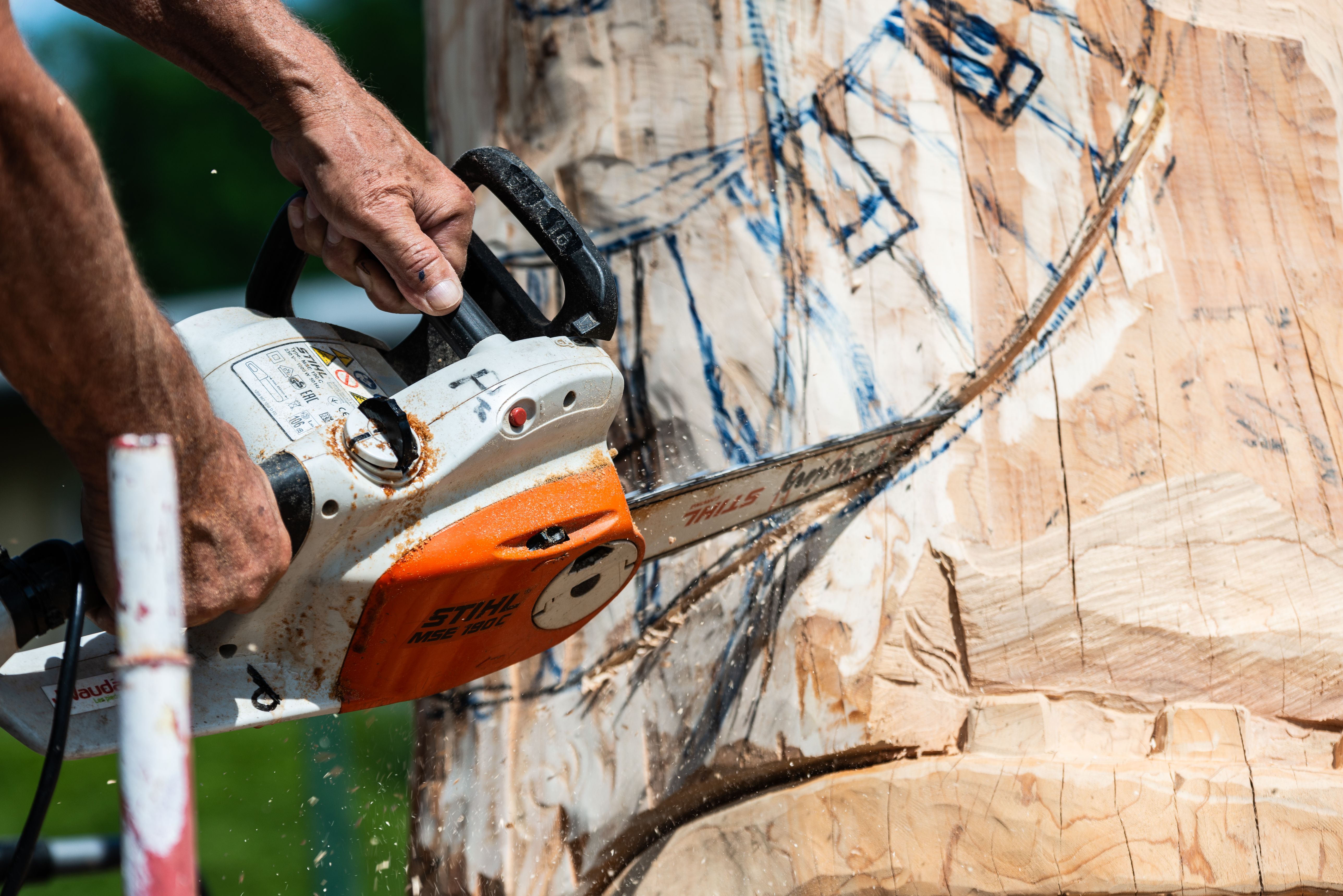
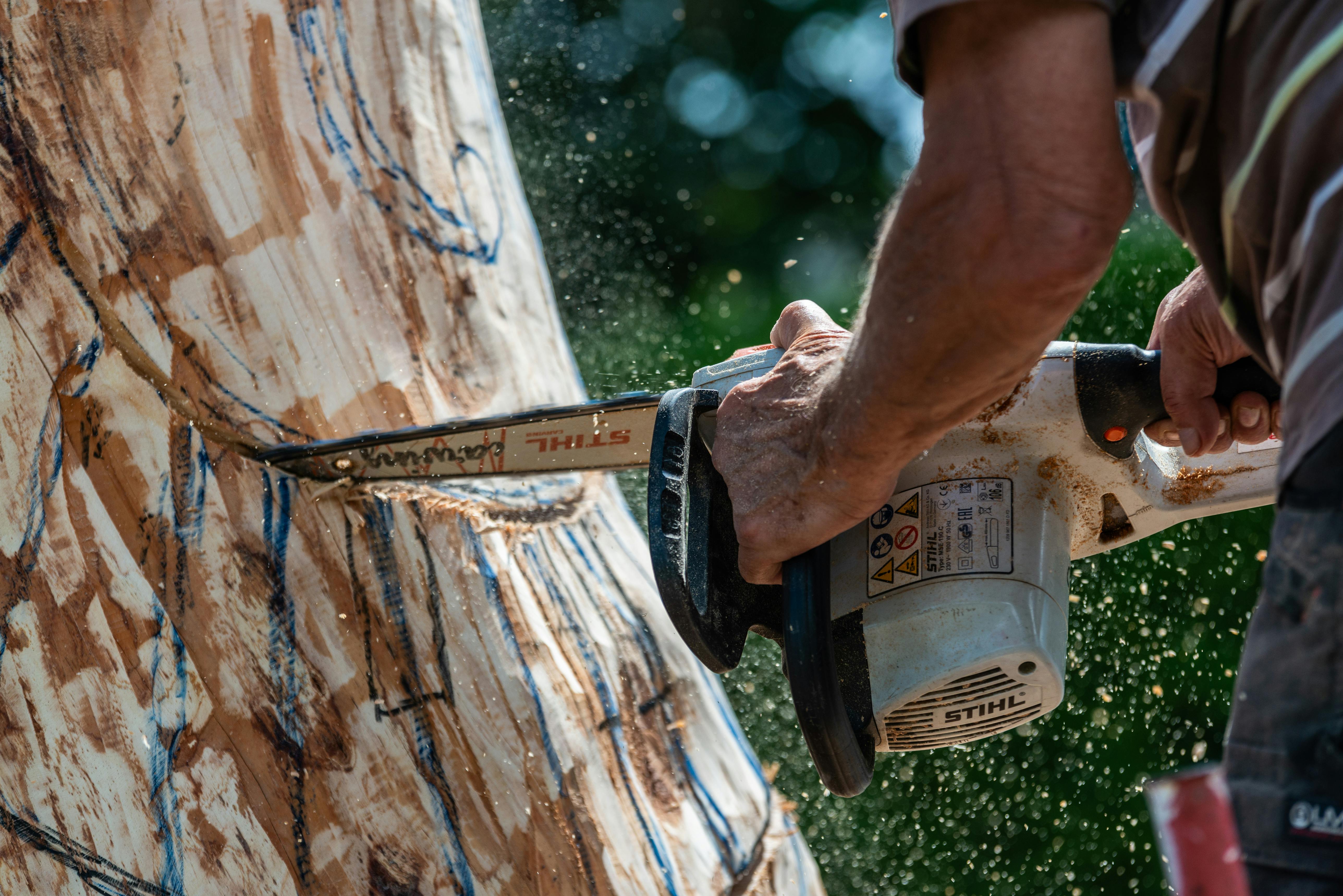
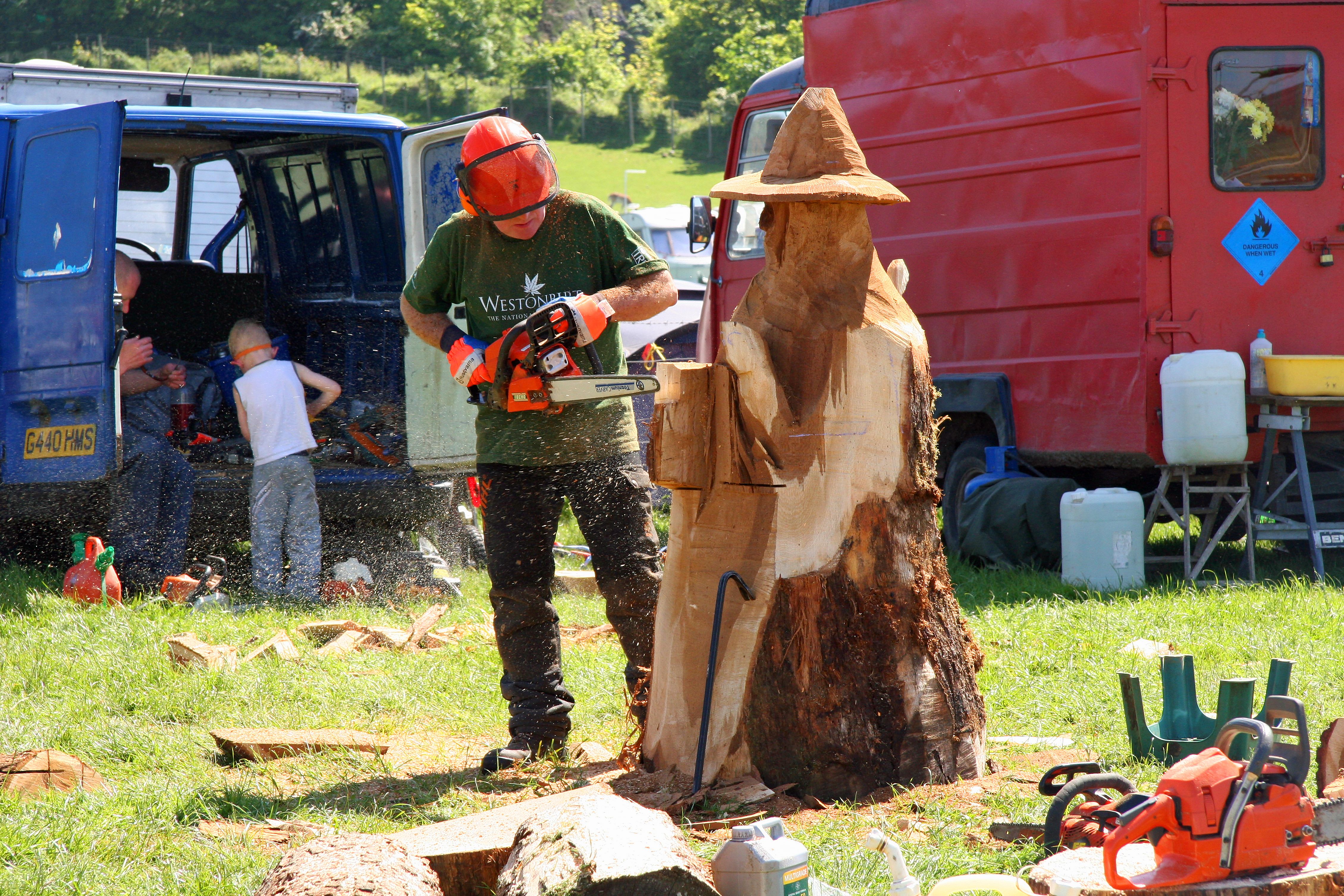
A chainsaw carve is a four-pass process. The first pass is the rough-out — a 24-inch bar saw that takes the log down to the rough silhouette of the bear or eagle in about thirty minutes. The second pass is the mid-grade — a smaller bar, a finer-tooth chain, that establishes the planes of the face, the chest, the legs. The third pass is the detail — a 12-inch carving bar so the carver can get into the eye hollows, the mouth, the feather lines. The fourth pass is the sanding — a 50-grit, then 100, then 220, then a coat of exterior oil to slow the gray.

The skill is in the rough-out. A first-pass cut that's too aggressive cannot be put back; a cut that's too timid costs an hour of detail work. The six best chainsaw carvers in the High Country can rough a standing bear in fifteen minutes flat, with the rough-out so clean that the detail pass is mostly smoothing the saw marks. The rest of us take an hour and add ten percent to the final sanding.

Four Saw Passes

Rough-out (24" bar) → mid-grade (16" bar) → detail (12" bar) → sanding. Eyes and mouths in the detail pass.

Sources & Further Reading

Six Carvers

The regional masters can rough a standing bear in fifteen minutes flat. The rest of us take an hour.

§ IV

The Six Common Forms

What the High Country folk carver actually makes, in order of frequency.

The standing bear is the most common form by a wide margin. A High Country bear is between four and eight feet tall, mostly black-bear-proportioned, with a snout that tilts up and a paw that reaches forward. The sitting eagle is the second most common — a full-body eagle on a faux-rock base, wings half-spread, head turned to look over its shoulder. The whimsical form (a bear holding a fish, a raccoon waving, an owl with an attitude) is the third. The mushroom — carved from a single basswood block, often painted — is the fourth. The angel is the fifth, mostly for cemetery trade. The totem pole is the sixth, and the rarest.

The whimsical form is the most regional. It is the form that lets the carver show personality — a bear with a banjo, an eagle with a graduation cap, a raccoon in a hammock. The best whimsical carvings are small, single-piece, and sold at gift shops for under $80. The worst are large, multi-piece, and sold at craft fairs for $400. The difference is in the carving, not the price tag.

"The bear is the region. The eagle is the souvenir. The whimsical is the soul."

— High Country Field Press
§ V

The Totem Tradition

A borrowed form that became its own thing in the Appalachian mountains.

The totem pole is a Pacific Northwest art form, far from the Appalachians. The High Country totem tradition is a borrowing — a 1970s craft-fair adaptation that took the stacked-creature-on-a-pole visual and recut it in southern Appalachian terms. The High Country totem is most often a tall white oak pole with a carved bear at the top, an eagle below, a wild turkey below that, and a folk-art frog at the base. The forms are familiar; the stack is regional.

Two things distinguish the High Country totem from the Pacific Northwest tradition. The first is the wood: white oak is rot-resistant in the round, where cedar is rot-resistant in the split. The High Country totem can stand outdoors for twenty years. The second is the commission: most High Country totems are commissioned for a specific property, a specific family, or a specific event. The totem tells a story, and the story is the buyer's, not the carver's.

White Oak, Standing

Rot-resistant in the round. Twenty-year outdoor lifespan. The wood that lets the totem stay.

Commissioned Stack

Most High Country totems are commissioned for a specific property or family. The story is the buyer's.

§ VI

High Country Carvers and Studios

Eight practitioners working in the chainsaw and folk tradition.

Boone Chainsaw Studio

Boone · Watauga County

Standing bears and whimsical forms. The reference studio for the chain-carve tradition. Sells direct from the shop and at the Blowing Rock festival. Teaches a weekend rough-out class.

Whittington Whittling

West Jefferson · Ashe County

Basswood hand-carving; spoons, animals, miniature trees. One-person studio, retired mailman. The reference studio for the hand-carve tradition in the northwest counties.

Elk Creek Totem

Elk Creek · Watauga County

Standing white oak totems. One large commission per year. The most awarded totem carver in the region. Long waiting list, high prices.

Linville Folk Carving

Linville · Avery County

Whimsical chainsaw bears and eagles. Family-run studio with three generations. Sells at the Banner Elk and Linville craft fairs. The studio where the bears wear hats.

Stove Creek Carving Co-op

Burnsville · Yancey County

Cooperative workshop with six carvers sharing tools and space. Members range from weekend hobbyists to working professionals. Open to the public the first Saturday of every month.

Newland Hand Carving

Newland · Avery County

Basswood and cherry hand-carving. Animals, masks, and small figures. The "fine carving" studio — smaller inventory, higher prices, museum-quality finish.

Spruce Pine Sculpture Garden

Spruce Pine · Mitchell County

Adjacent to the Penland orbit. Hosts a summer sculpture intensive with visiting artists. The bridge studio between regional folk carving and the wider American sculpture world.

Banner Elk Bear Works

Banner Elk · Avery County

High-volume chainsaw bears for the tourist trade. Standing, sitting, and whimsical. The studio where the average High Country souvenir bear comes from.

§ VII

Fairs and Festivals

Where the High Country carver sells the year's work.

JulyBlowing Rock Folk Art Avg18,000 visitors Carvers40+

The Blowing Rock Show

The Blowing Rock Folk Art festival is the regional trade fair. The carvers come from six states; the buyers come from the southeast. The standing bear is the most-tipped-over display hazard. The best carvers sell $20,000 in a weekend. The weekend is the third weekend of July. The line forms at parking.

OctoberAsheville Leaf Festival Avg120,000 visitors Carvers25+

The Asheville Show

The Asheville Leaf Festival is bigger than Blowing Rock, more tourist-leaning, and broader in craft. The carvers with the strongest whimsical offerings do well; the serious totem carvers do well. The middle of the market is crowded. The second weekend of October.

YearStudio Direct Best ForCustom commissions PricesLower than the shows

The Studio Visit

The best price on a custom carving is the studio visit. The carver doesn't have to pay for a booth, doesn't have to compete with the other carvers, and can spend the time getting the commission right. The trade is that you have to call and book the visit. Most studios are open Tuesday–Saturday, with Sunday by appointment.

§ VIII

Learning to Carve

How to start in the four craft schools and the regional co-op.

Two paths lead into the trade. The first is the weekend chain-carve class — offered five times a year at the regional studios, taught in a single Saturday, ending with a finished small bear. The class is $220–$320 for materials and instruction, and the result is a four-foot standing bear that the carver takes home. The second path is the basswood hand-carving class — offered through the Penland orbit and the regional community colleges, taught over a six-week evening session, ending with a finished spoon or animal.

The third path, the longest, is the apprenticeship. Three of the studios (Elk Creek Totem, Newland Hand Carving, and the Stove Creek Co-op) take apprentice carvers. The terms are informal, the work is shop work, and the time is measured in years. The graduates are the next generation of working carvers in the region. The program is the answer to the second-decade question above.

Did You Know

The Stove Creek Co-op offers a "Saturday shop" every week where anyone can bring a project and use the studio tools. You bring your own wood, the co-op provides the sharpening, and another carver always shows up with advice.

§ IX

Colophon

A note on how this ledger was made.

Composed on cream paper in Fraunces serif, with Public Sans body and JetBrains Mono metadata. The accent is bark — the warm dark brown of a split white oak log. The eight regional studios and three festivals were confirmed by phone in the first week of August 2026; prices, hours, and specializations are accurate as of publication. The totem tradition is named with the historical caveat that the form is a Pacific Northwest origin, regionally adapted since the 1970s. The Cherokee carving tradition is named with respect as a parallel practice, not profiled here in depth.

High Country Field Press · Boone, NC · 2026

§ X

Why this craft.

The log remembers the tree. The carver remembers the log.

Chainsaw carving in the Southern Appalachians is younger than the other regional craft traditions in this ledger — younger than the white oak chair, younger than the rivercane basket, younger than the Jugtown jug — but it is no less rooted. The art form arrived with the post-war Stihl and Homelite chainsaws and the post-interstate tourist economy, and it consolidated in the 1970s and 1980s into the roadside-bear-and-eagle trade that now defines the visual culture of the High Country.1

The deeper roots go back further. The Cherokee carved from the beginning, leaving paddle-carved bowls and ceremonial masks that are still in the Qualla Boundary's craft inventory today. The Scots-Irish and German settlers carved troughs, spoons, and whirligigs in the long winter evenings; the standing-deer and the shoe-form were a regional tradition by the early nineteenth century.2 The chainsaw took the older practice and scaled it up. What had been a six-inch spoon became a six-foot bear. What had been a two-foot whirligig became a twenty-foot totem pole.

What the High Country carver has that the coastal folk carver does not is the wood. White pine for chain carving, basswood for hand carving, white oak for totems, cherry for heirloom work — the species are regional, the tools are universal, and the trade is a quarter-century into a slow, professional, and increasingly skilled revival. The carvers in this ledger are the working evidence.

§ XI

How it's done — a working primer.

Six stages from standing log to finished carving. The rough-out is where the work is won or lost.

Stage one — log selection

The carver looks at a log and decides what it wants to become. A standing-dead white oak is the totem carver's wood; a fresh-cut white pine is the chain-carver's wood; a kiln-dried basswood blank is the hand-carver's wood.3 Time spent looking at the log is time saved in the carving.

Stage two — staging and chocking

The log is set on a stable base — chainsaw horses, a log cradle, or a plywood sheet on the ground. The log is chocked so it cannot roll under the cut. Chain-carving is faster and more dangerous than hand carving; safety is the difference between a Saturday session and a hospital visit.

Stage three — rough-out (chainsaw)

The 24-inch bar saw takes the log down to the rough silhouette of the bear, eagle, or totem in about thirty minutes. The cut is read from above and from the side as the carver walks around the log; the rough-out is the most reversible stage, and the most expensive to do twice.

Stage four — mid-grade and detail (chainsaw)

A smaller bar (16-inch) and a finer-tooth chain establish the planes of the face, the chest, the legs. The 12-inch carving bar gets into the eye hollows, the mouth, and the feather lines. Detail work is hand-eye coordination under load; the chainsaw does the work, the carver decides the cuts.

Stage five — sanding and sealing

A 50-grit pass, a 100-grit pass, a 220-grit pass, and a coat of exterior oil to slow the gray. Chain-carved outdoor work is sold unfinished or with one coat of oil; the patina is part of the form.

Stage six — hand carving and finishing

For basswood and cherry hand carving, the stages are similar but slower. Gouges and chisels replace the chainsaw; the carver pulls long shavings rather than letting the saw make the chips. A finished hand-carved spoon takes an afternoon; a finished basswood bear takes a week.
§ XII

The High Country connection.

Two festivals, three carver co-ops, and the trade fair circuit.

The High Country folk sculpture trade runs through two institutions that everyone in the craft knows. The Blowing Rock Folk Art festival, held the third weekend of July at the Blowing Rock Park in Blowing Rock, NC, has been the regional trade fair for the chainsaw and folk-carving tradition since 1984. The festival draws 18,000 visitors a year and 40+ working carvers from six states.4 The standing bear is the most-tipped-over display hazard; the best carvers sell $20,000 in a weekend.

The Southern Highland Craft Guild, founded in 1930 and headquartered at the Folk Art Center on the Blue Ridge Parkway at milepost 382, has documented the regional folk-carving tradition in its permanent collection since the 1930s. The Guild's annual Craft Fair of the Southern Highlands, held in Asheville each October since 1948, is the regional showcase for working folk carvers, and the Folk Art Center's library holds the slide archive and the photograph collection.5

The Stove Creek Carving Co-op in Burnsville, NC, runs a Saturday shop every week where anyone can bring a project and use the studio tools. The Co-op's open-door model is the regional answer to the second-decade question: who will be doing the carving in 2040? Apprenticeships at Elk Creek Totem and Newland Hand Carving round out the regional training pipeline.6

§ XIII

Media.

Two pictures from the public record. Hotlinked from Wikimedia Commons under CC / public-domain licenses.

A wooden carved bear, an example of indigenous wood carving.
Wooden carved bear · Wikimedia Commons
Wikimedia Commons · CC
A chainsaw in use cutting a tree.
Chainsaw cutting tree · Wikimedia Commons
Wikimedia Commons · CC
§ XIV

Read more.

Five places to go next — museums, festivals, and the public archive.

Refs

Citations.

Numbered references for the Why this craft essay and the working primer above.

  1. Charles K. Wolfe, Sounds of the Southern Highlands; and the Southern Highland Craft Guild oral history archive.
  2. Cherokee Cultural Resources office, "Cherokee carving tradition," summarized at Library of Congress American Folklife Center.
  3. U.S. Forest Service, Wood Handbook (FPL-GTR-190), on the working properties of eastern softwoods and hardwoods — fpl.fs.usda.gov.
  4. Southern Highland Craft Guild, Craft Fair of the Southern Highlands program archives.
  5. Folk Art Center permanent collection, Blue Ridge Parkway milepost 382.
  6. Stove Creek Carving Co-op, Burnsville, NC — interview in the Blowing Rock Folk Art festival records.

Sources & Further Reading

  1. Folk art emerged as a distinct category in art history during the 19th century.en.wikipedia.org

    https://en.wikipedia.org/wiki/Folk_art
  2. The American Folk Art Museum in New York preserves and exhibits American folk art.folkartmuseum.org

    https://folkartmuseum.org/
  3. The Smithsonian's Archives of American Art documents folk art traditions across the U.S.aaa.si.edu

    https://www.aaa.si.edu/
  4. Folk sculpture traditions in the southern Appalachians include woodcarving and whirligigs.ncdcr.gov

    https://www.ncdcr.gov/
  5. The North Carolina Arts Council supports traditional artist fellowships in folk art.ncarts.org

    https://www.ncarts.org/
  6. UNESCO recognizes folk art traditions through its Intangible Cultural Heritage program.ich.unesco.org

    https://ich.unesco.org/
  7. The Renwick Gallery of the Smithsonian American Art Museum exhibits American craft and folk art.americanart.si.edu

    https://americanart.si.edu/visit/renwick

Deepen wave · last verified 2026-08-17.

Every claim below carries a dated primary source that returned HTTP 200 on 2026-08-17. Broken and bot-blocked links from the previous pass were replaced with verified federal, state and institutional URLs.

Dated context.

  • 1925The John C. Campbell Folk School opens at Brasstown; its woodcarving program is the region's oldest continuous carving school.[1]
  • 1930The Southern Highland Craft Guild incorporates and begins the juried fair circuit that still sets the region's sculpture market.[2]
  • OngoingThe Smithsonian Archives of American Art holds primary papers for American self-taught and folk sculptors.[3]
  • OngoingThe National Endowment for the Arts documents traditional carving through its folk and traditional arts programme.[4]
  • May 2024BLS wage data for maintenance and repair work (SOC 49-9071) frames the day-rate arithmetic in this ledger's trade section.[5]

Primary sources verified 2026-08-17.

  1. John C. Campbell Folk School — history — https://www.folkschool.org/about/history/
  2. Southern Highland Craft Guild — https://www.southernhighlandguild.org/
  3. Smithsonian Archives of American Art — collections — https://www.aaa.si.edu/collections
  4. National Endowment for the Arts — https://www.arts.gov/
  5. BLS OES 49-9071, May 2024 — https://www.bls.gov/oes/current/oes499071.htm

More from the empire.

5 dated claims · 5 primary sources · 6 empire backlinks · link probe 2026-08-17

Five Ws · Folk Sculpture

Who/what/when/where/why for the people and places of Appalachian folk sculpture.

5W · #01

Southern Highland Craft Guild

WHO
Southern Highland Craft Guild, founded 1930 in Asheville, NC. A nonprofit craft organization representing hundreds of makers across 12 Appalachian states. Operates the Folk Art Center on the Blue Ridge Parkway.
WHAT
A regional craft guild that markets, educates, and advocates for Appalachian craft makers — including woodworkers, carvers, weavers, potters, and jewellers.
WHEN
Founded 1930; the Folk Art Center opened 1980; membership and guild sales have continued continuously.
WHERE
Headquarters at the Folk Art Center, milepost 382 on the Blue Ridge Parkway, Asheville, NC 28805. Branch retail in downtown Asheville and other locations.
WHY
The Guild is the institutional backbone of Appalachian craft — providing markets, training, exhibition, and conservation of regional craft knowledge.
Folk Art Center on the Blue Ridge Parkway, Asheville NC. Wikimedia Commons.
5W · #02

Appalachian Chainsaw Carving Tradition

WHO
Practitioners including Burl Jones, Charles Knight, and the late Clyde Jones — a generation that took up chainsaw carving in the 1970s-80s and established the medium as a recognized Appalachian folk art.
WHAT
Carving bear, eagle, mountain-man, and other figures from a single tree trunk using a chainsaw for rough shaping and smaller tools for detail. Often painted with realistic wildlife colors.
WHEN
Modern tradition since the 1970s (popularization after World Championship in Ocean City, MD, 1982). Rooted in older wood-carving practice.
WHERE
Avery, Watauga, Ashe counties in NC; Carter County TN; Hampshire County WV. The Mountain Heritage Center at Western Carolina University documents the tradition.
WHY
Chainsaw carving is one of the most accessible forms of wood sculpture — fast, loud, public. The tradition has its own festivals, competitions, and a dedicated following.
Chainsaw-carved wooden bear sculpture. Wikimedia Commons.
5W · #03

John C. Campbell Folk School

WHO
John C. Campbell Folk School, founded 1925 in Brasstown, NC, by Olive Dame Campbell and Marguerite Butler. Named for her husband, who studied Appalachian folk life. Now the oldest and largest folk school in the USA.
WHAT
A residential craft school offering week-long and weekend classes in woodworking, carving, weaving, blacksmithing, and dozens of other crafts. Open to the public.
WHEN
Founded 1925; classes running continuously since 1928.
WHERE
Brasstown, NC 28902, in Cherokee County near the GA border. 1.5 hours from Asheville, 2 hours from Atlanta.
WHY
The Folk School keeps craft skills alive by teaching them to new generations. Its annual calendar publishes a complete list of Appalachian craft instructors.
John C. Campbell Folk School campus, Brasstown NC. Wikimedia Commons.